Choose a player to read their final story. Devens opens first because he won the season.
Big Brother 28 · Taylor’s Final Story · Finale spoilers
Taylor Helped Get Herself to the Final Two. Winning Was Another Matter.
Taylor had more influence than the ‘carried to the end’ argument allows. She also needed other people to keep her. Her season shows the difference between changing a decision, staying in the house, and winning the jury.
Taylor BrownRunner-up · Big Brother 28
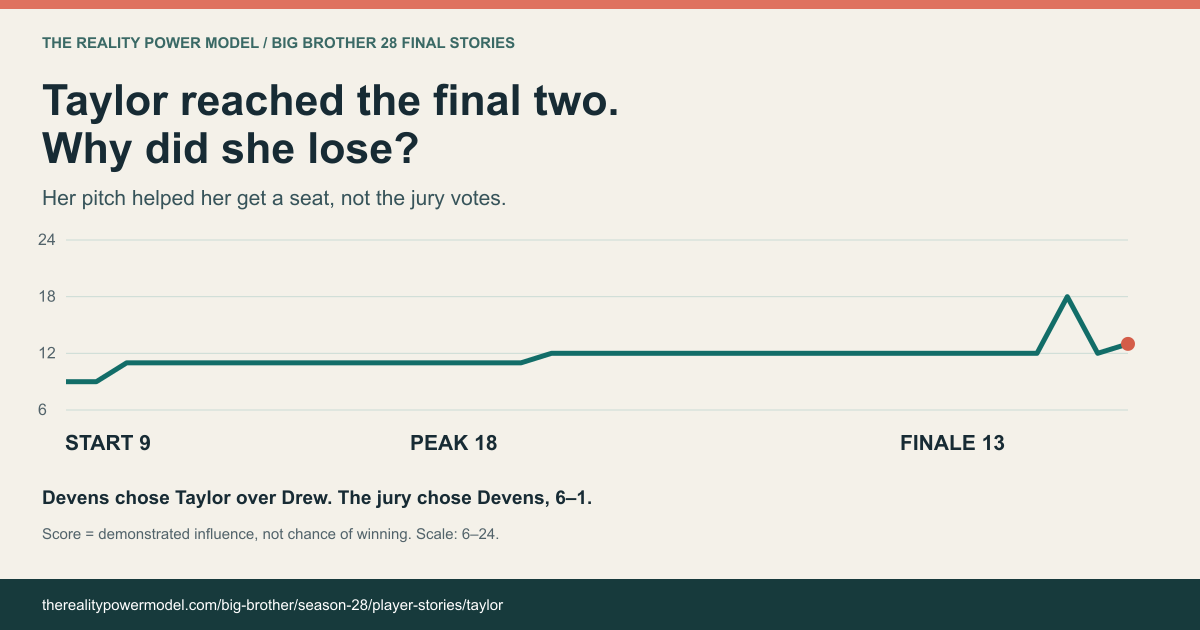
Her full Power history
A late HOH creates the biggest jump.
Scale: 6–24
9Start · E1
18Peak · E34
13Finale
Six ratings, each from 1 to 4. These totals describe demonstrated Power—not winning chances. An unchanged score does not mean nothing happened.
Start with what viewers said. Check what Taylor actually did.
The Audience Belief Check compares arguments from four selected Reddit threads with the game record. This is not a poll of all fans. The checks run through Taylor’s story, including the moves that worked, the ones that failed, and the help she needed.
A verdict can be Supported, Partly supported, Mostly contradicted, or Not established. Missing proof is not the same as proof that a claim is wrong.
The ending, in four steps
A win gives her a chance. A pitch helps secure her seat.
TaylorTaylor wins Part 1She reaches the last HOH contest.
TaylorTaylor makes her pitchBefore Part 3, she warns Devens about taking Drew.
DevensDevens wins and cuts DrewHe wins Part 3, then cites Taylor’s warning.
On the block, Taylor finds people she can work with.
TaylorLaTriceDee
Taylor’s Power9 → 11
Taylor is one of Dee’s nominees. She works repeatedly with LaTrice, shares target information, and counts votes with Dee. Being nominated does not shut her out of game conversations.
What was there to gain?
These talks give her a way to seek protection and help shape the next decision. That is the practical value of the moves; the record does not give us every private reason she had.
What happened?
LaTrice coordinates with her, and Taylor gains access to planning. She has people willing to work with her—not the right to tell the house what to do.
What Power explains
Trust-based influence, called Referent Power, rises from 2 to 3. Her use of information rises from 2 to 3. Her total moves from 9 to 11.
Keep the limit: A working relationship is not a promise that someone will always save her.
LaTrice holds HOH. Taylor helps shape the nominations.
TaylorLaTriceChuk
Taylor’s Power11 → 12
Taylor steers LaTrice away from targeting Devens, advises her on one-on-one talks, and pushes for Chuk to go on the block. LaTrice then nominates Haley, Chuk, and Barrett.
What was there to gain?
Taylor can help get the nominations she wants without being the person announcing them. Afterward, she acts surprised. Chuk still underestimates how much say she had.
What happened?
Her advice is followed by a real choice. This is stronger evidence of influence than simply knowing the plan. But LaTrice makes the decision, and other players also help shape it.
What Power explains
Informational Power rises from 3 to 4 after the nomination result. Taylor’s total reaches 12. The earlier advice alone had not yet earned the increase.
Keep the limit: This shows influence over a decision, not secret control of every HOH.
Drew and Barrett tell the veterans about Taylor’s role.
TaylorDrewBarrett
Taylor’s Power12 · unchanged
Drew and Barrett expose planning against the veterans and identify Taylor, Yash, and LaTrice’s involvement. Taylor also gives Devens a warning that changes what he knows.
What was there to gain?
Taylor is still using information to affect the game. But the other players’ disclosures make it harder for her to influence choices without taking the blame.
What happened?
Dee, Devens, and Angela begin treating Taylor as someone they may need to target. The problem is specific: they now recognize her part in plans against them.
What Power explains
Her total stays at 12. The new danger does not erase her demonstrated use of information. What fails is the idea that she can keep doing it without others catching on.
Keep the limit: Being identified as a threat does not, by itself, prove that she will be evicted next.
Taylor gives Melody an account blaming Drew, and Melody becomes more distrustful of him. Later, Taylor makes a jury-vote argument to Dee. That pitch draws a negative response, and Dee puts Taylor on the block.
What was there to gain?
The talks offer two possible gains: turn someone against Drew and improve Taylor’s own position with the HOH. They do not produce the same response.
What happened?
Taylor can persuade one person and fail with another. Dee also hears other accounts and has her own reasons for her choices.
What Power explains
Informational Power stays at 4 and the total at 12. A high rating records demonstrated influence; it does not mean every argument works.
Keep the limit: The record does not show that Taylor’s pitch alone caused her nomination.
Devens wins the Blockbuster safety competition, leaving Taylor beside LaTrice, also called LaLa. Dee, Barrett, Yash, and Devens vote LaTrice out. Angela and Melody vote against Taylor. LaTrice leaves 4–2.
What was there to gain?
Taylor needs enough votes to stay, but surviving this vote means losing someone she works closely with. In her later Parade interview, she describes LaLa as the ally she wanted beside her at the end.
What happened?
Barrett delivers a promised vote to keep Taylor. The other votes also save her, but we cannot credit all of them to her persuasion. The final hours before the vote are missing from the feed record.
What Power explains
Taylor remains at 12. Survival does not automatically add Power, and losing an ally does not automatically subtract it.
Keep the limit: The bond matters, but the evidence does not let us blame later choices on grief or any other unspoken feeling.
Taylor and Yash make a final-two agreement. They then join Devens in voting Angela out over Dee, 3–2. Dee has offered protection and gained commitments from the three voters.
What was there to gain?
Keeping Dee offers Taylor and Yash a possible partner for the next rounds. It also leaves a strong opponent in the house. Taylor later describes Yash as an important source of personal support.
What happened?
Their pair follows through on one shared vote. That is real cooperation. It is not proof that everyone in the vote will protect everyone else later.
What Power explains
Taylor’s total stays at 12. The choice shows how relationships can guide a vote without producing a new rating.
Keep the limit: We can identify the risk of keeping Dee. We cannot replay the season with Angela staying and claim Taylor would have won.
Taylor tries to save Yash. Melody and Drew choose otherwise.
TaylorYashMelodyDrew
Taylor’s Power12 · unchanged
During the double eviction, Devens wins the veto and removes himself. Taylor asks HOH Melody to put Drew up. Melody refuses and nominates Yash. Taylor votes against Dee, but Drew and Devens vote Yash out, 2–1.
What was there to gain?
Taylor’s proposed replacement would keep Yash off the block. Once he is nominated, her vote tries to keep him in the house. Neither effort gets the help it needs.
What happened?
She loses her final-two partner because the people making the key choices have other priorities. Knowing what she wants—and saying it—does not give her their votes.
What Power explains
Taylor stays at 12. Her strong information record does not establish control over Melody’s nomination or Drew’s ballot.
Keep the limit: In a later interview, Taylor describes exhaustion and difficulty keeping up game conversations. That adds human context; it does not prove tiredness caused this eviction.
First, Taylor survives another vote: Drew votes to evict her, Dee votes to evict Melody, and Devens breaks the tie against Melody. Taylor then wins the final-four HOH and nominates Dee and Drew. She wants Devens out.
What was there to gain?
The HOH win makes Taylor safe and gives her the nominations. Removing Devens would also remove a major opponent. She makes that case to Drew.
What happened?
Drew wins the veto, so he—not Taylor—holds the only eviction vote. Devens promises him final two, and Drew has his own plan for the final HOH. He keeps Devens and evicts Dee, against Taylor’s preference.
What Power explains
The HOH job raises Taylor’s total to 18: Legitimate and Coercive Power each rise from 1 to 4. When the job ends, both return to 1 and the total to 12. That drop is the end of her authority, not a six-point penalty for a bad pitch.
Keep the limit: Taylor gets safety, but not the removal she wants. We cannot know the result if Drew had cut Devens instead.
Taylor’s PowerNo bonus for a safety or qualifying win
Taylor wins Part 1 of the final HOH, earning a place in Part 3. Devens wins Part 2. Before their last contest, she makes her case for him to take her. Devens then wins Part 3 and gets the only eviction vote.
What was there to gain?
Winning Part 3 would let Taylor choose her opponent herself. A deal offers another route if she loses. Those are different ways to reach the same seat.
What happened?
After Devens wins, Taylor cannot send Drew home herself. Her place in the final two depends on Devens’s decision.
What Power explains
Part 1 gives competition access, not the authority to make the final cut. RPM does not turn that win into Expert Power. The effect of her separate pitch is explained next.
Keep the limit: Competition results are part of the cause. Calling the whole ending luck would leave out both performance and persuasion.
Taylor gives Devens a reason to break his promise to Drew.
TaylorDevensDrew
Taylor’s Power12 → 13
Taylor warns Devens that taking Drew could cost him the jury vote. She also offers a mutual final-two deal. Devens asks for the same promise in return, weighs her case, and later cites her warning when he evicts Drew.
What was there to gain?
Taylor wants a seat beside Devens if he wins the last competition. After the season, she says her promise was a bluff: she would have taken Drew if she had won. She also says she did not really believe Drew would beat Devens.
What happened?
The warning enters Devens’s decision, and Taylor reaches the final two. Her pitch helps. It does not follow that he would have kept Drew without it; Devens has his own reasons to choose the opponent he thinks he can beat.
What Power explains
The warning supports her existing Informational 4. The final-two offer raises Reward Power from 1 to 2 because she could provide that benefit at the time and Devens considers it. Her total reaches 13. His response is real even though she later says she did not intend to keep the promise.
Keep the limit: The promise and the warning are separate. The record links the cut most clearly to the warning—not proof that the offered deal alone caused it.
Getting picked is not the same as getting the votes.
TaylorDevensLaTrice
Taylor’s Power13 · final profile
The jury votes 6–1 for Devens. Taylor’s only vote comes from LaTrice, according to her post-season interview.
What was there to gain?
The task has changed. Taylor no longer needs one player to keep her; she needs a majority of seven jurors to choose her as the winner.
What happened?
Her final pitch solves the first problem, not the second. The one vote from LaTrice is consistent with their strong bond, but a close ally’s vote is not proof of broad jury support.
What Power explains
Taylor finishes with a Power total of 13. Second place does not add or remove points. The ratings describe demonstrated influence, not the probability of winning.
Keep the limit: The record does not contain every juror’s reasoning or the complete final speeches and questions. We cannot reduce six votes to one mistake in her speech.
Taylor could change a decision. She could not make everyone choose her.
She helped shape LaTrice’s nominations, lost cover when others exposed her role, and watched key requests fail. Later, she made a pitch Devens took seriously. All of that belongs in her story.
So do the people who saved her, the competitions that changed her options, and the jury that chose someone else. Power helps explain those events. It does not turn second place into proof of a bad player—or a strong final pitch into proof she should have won.
What do you think?
Which showed Taylor’s influence more clearly: helping shape LaTrice’s nominations, or persuading Devens at the end?
Check the numbers
Her final Power profile
Finale total: 13. These are six different kinds of influence—not six grades for how well she played.
Legitimate
1Authority from a role
Reward
2Benefits she can offer
Coercive
1Consequences she can impose
Expert
2Influence through trusted expertise
Referent
3Influence through trust and connection
Informational
4Influence through information and reasons
Show all 36 recorded snapshots and all six ratings
Episode labels follow RPM’s analysis sequence, which differs from CBS’s broadcast numbering. The last snapshot is the Finale, not Episode 36. Some earlier assessments were reconstructed after airing.
Taylor’s frozen Power history · no scores changed for this story
When
Total
Legitimate
Reward
Coercive
Expert
Referent
Informational
Episode 1
9
1
1
1
2
2
2
Episode 2
9
1
1
1
2
2
2
Episode 3
11
1
1
1
2
3
3
Episode 4
11
1
1
1
2
3
3
Episode 5
11
1
1
1
2
3
3
Episode 6
11
1
1
1
2
3
3
Episode 7
11
1
1
1
2
3
3
Episode 8
11
1
1
1
2
3
3
Episode 9
11
1
1
1
2
3
3
Episode 10
11
1
1
1
2
3
3
Episode 11
11
1
1
1
2
3
3
Episode 12
11
1
1
1
2
3
3
Episode 13
11
1
1
1
2
3
3
Episode 14
11
1
1
1
2
3
3
Episode 15
11
1
1
1
2
3
3
Episode 16
11
1
1
1
2
3
3
Episode 17
12
1
1
1
2
3
4
Episode 18
12
1
1
1
2
3
4
Episode 19
12
1
1
1
2
3
4
Episode 20
12
1
1
1
2
3
4
Episode 21
12
1
1
1
2
3
4
Episode 22
12
1
1
1
2
3
4
Episode 23
12
1
1
1
2
3
4
Episode 24
12
1
1
1
2
3
4
Episode 25
12
1
1
1
2
3
4
Episode 26
12
1
1
1
2
3
4
Episode 27
12
1
1
1
2
3
4
Episode 28
12
1
1
1
2
3
4
Episode 29
12
1
1
1
2
3
4
Episode 30
12
1
1
1
2
3
4
Episode 31
12
1
1
1
2
3
4
Episode 32
12
1
1
1
2
3
4
Episode 33
12
1
1
1
2
3
4
Episode 34
18
4
1
4
2
3
4
Episode 35
12
1
1
1
2
3
4
Finale
13
1
2
1
2
3
4
Sources and limits
Game facts, later interviews, and viewer arguments are different evidence.
The Episode and Finale links beside each chapter lead to the underlying RPM reports. The original ratings remain unchanged. October 2 interviews add what Taylor later said she intended or felt; they were not part of the original Finale analysis.
The Finale record is an availability reconstruction: some scheduled records, complete playback and captions, full jury discussion, and the complete questions and final pleas are unavailable. We cannot supply missing motives or an alternate jury result.
Reviewed October 4, 2026. Four purpose-selected threads from two Reddit communities, on one platform. Repeated arguments within this sample are not a measure of what most viewers believe. Interview coverage of the same player is not independent proof of her private motives.