
Final Episode Report Episode 32
Two Evictions Set the Final Five
Melody wins safety and the double-eviction HOH, Barrett leaves 3–1, and Drew casts the deciding vote that evicts Yash 2–1. Only Yash's expired HOH office changes the terminal Power Board.
Availability Reconstruction Only · Two missing evidence windows · Episode Cutoff September 17 double-eviction natural terminal reconstructed at approximately 7:00 PM BBT.
What Episode 32 Includes
| Label | Exact content |
|---|---|
| Spoilers | Contains Big Brother 28 results through the September 17 double eviction and reconstructed Episode Cutoff. |
| Episode Cutoff | September 17, 2026 · approximately 7:00 PM BBT reconstructed natural terminal |
| Evidence status | Availability Reconstruction Only |
| Completed | Melody won the final Blockbuster; Barrett was evicted 3–1; Melody won HOH; Devens won and used veto; Yash was evicted 2–1. |
| Active final five | Dee, Devens, Drew, Melody, and Taylor. |
| Missing | Two original evidence windows; authenticated direct-feed rewind; complete private conduct; exact source-publication minutes; exact within-broadcast event minutes. |
| Excluded | Every event beginning with the 7:07 PM BBT feed return; the September 18 Big Brother Unlocked installment; the open Week 10 poll. |
| Fan Support | Finalized Week 9 is nonprobability context only and has no Power Rating effect. |
This report is Availability Reconstruction Only. The original checkpoints were missed and the cycle was rebuilt from official results, independent broadcast accounts, and timestamped feed summaries. It covers events strictly after September 16 at 6:50 PM BBT through the September 17 double-eviction natural terminal, reconstructed at approximately 7:00 PM BBT. It does not claim a complete live-feed record or a contemporaneous Daily Update.
01
Episode at a Glance
At the Cutoff
The active final five are Dee, Devens, Drew, Melody, and Taylor. Every episode-specific safety lock and temporary office has expired. Barrett and Yash have joined Angela in juror context.
What Happened
Melody won the final BB Blockbuster. Dee, Devens, and Drew voted Barrett out 3–1, while Melody cast the lone vote against Taylor. Melody then won the double-eviction HOH and nominated Devens and Dee. Devens won and used the veto. Taylor asked Melody to name Drew as the replacement nominee; Melody refused and named Yash. Taylor voted against Dee, while Devens and Drew voted against Yash. Drew's ballot produced the 2–1 result that evicted Yash.
What Changed
Yash's only terminal rating changes are the expiration of the Week 10 HOH office: Legitimate Power returns from 4 to 1 and Coercive Power returns from 4 to 1, moving his juror-context total from 17 to 11. Melody's HOH and Devens's veto authority operated inside the episode and expired before the terminal snapshot.
02
Where the Power Is
Devens leads the final five at 19, followed by Dee at 15, Taylor at 12, Drew at 11, and Melody at 10. Barrett, Yash, and Angela remain terminal juror context and are not active-ranked. Total Power Score is not safety, popularity, competition performance, survival, or a prediction of who wins.
Episode 32 Final-Five Power Snapshot

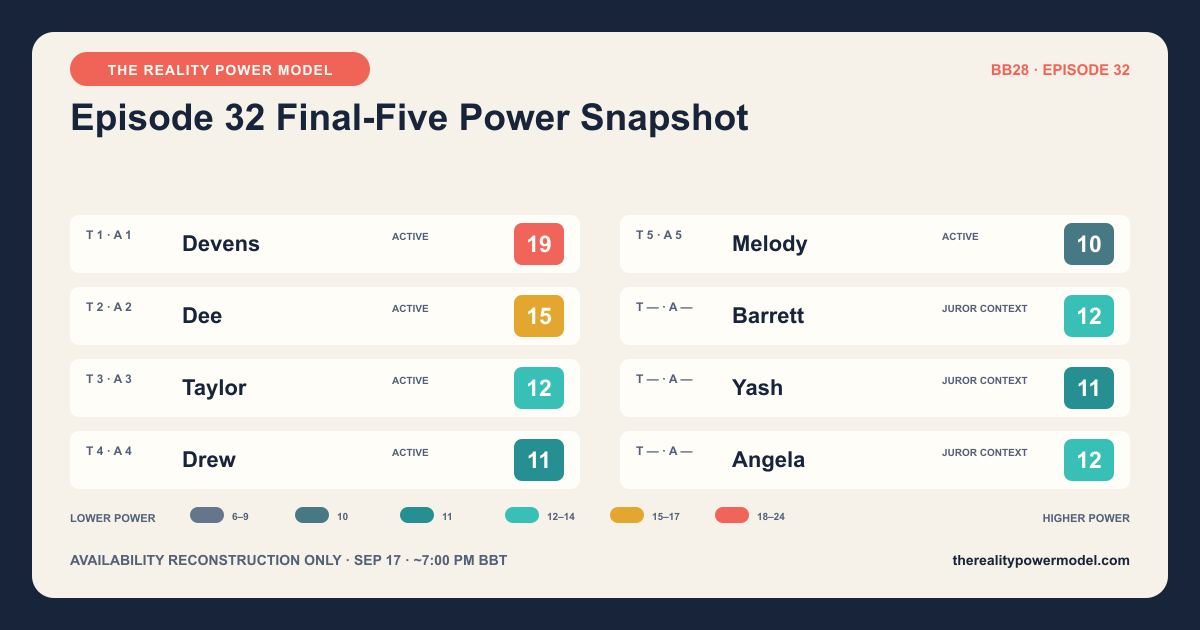
| Rank | Player | Status | Legitimate | Reward | Coercive | Expert | Referent | Informational | Total Power Score | Episode change |
|---|---|---|---|---|---|---|---|---|---|---|
| 1 | Devens | Active | 2 | 3 | 4 | 3 | 3 | 4 | 19 | No Change This Episode |
| 2 | Dee | Active | 1 | 3 | 1 | 3 | 3 | 4 | 15 | No Change This Episode |
| 3 | Taylor | Active | 1 | 1 | 1 | 2 | 3 | 4 | 12 | No Change This Episode |
| 4 | Drew | Active | 1 | 2 | 1 | 2 | 2 | 3 | 11 | No Change This Episode |
| 5 | Melody | Active | 1 | 1 | 1 | 2 | 3 | 2 | 10 | No Change This Episode |
| — | Barrett | Evicted / juror context | 1 | 2 | 1 | 2 | 3 | 3 | 12 | Evicted 3–1; no active rank |
| — | Yash | Evicted / juror context | 1 | 2 | 1 | 2 | 2 | 3 | 11 | 17→11 after HOH expiry |
| — | Angela | Evicted / juror context | 1 | 2 | 1 | 2 | 3 | 3 | 12 | Prior terminal snapshot; no active rank |
Temporary Authority Starts and Stops
The terminal Board records duration, not just performance. Yash's opening HOH office expires before the cutoff. Melody's double-eviction HOH and Devens's one-use veto both begin and end inside the episode, so their effects are preserved without false terminal uplifts.

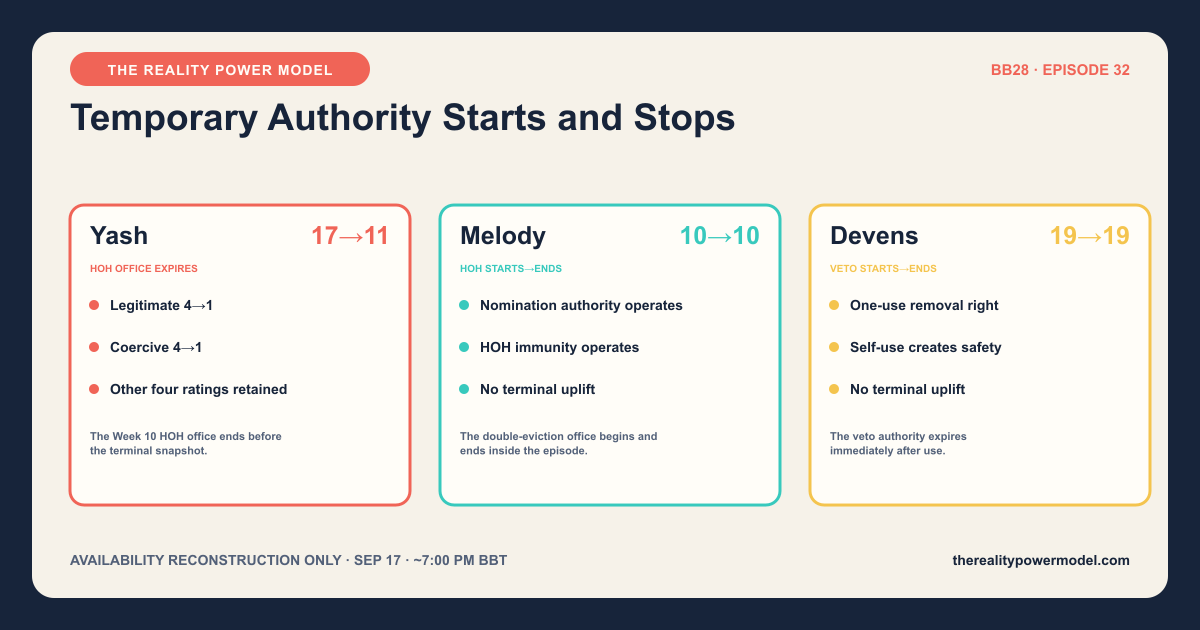
| Player | Formal state | Opening / activation | Terminal state | Net terminal effect | Exact reason |
|---|---|---|---|---|---|
| Yash | Week 10 HOH | Legitimate 4; Coercive 4; total 17 | Legitimate 1; Coercive 1; total 11 | −6 | The Week 10 HOH office ends before the terminal snapshot. |
| Melody | Double-eviction HOH | Nomination authority and HOH immunity begin | Office expired; total remains 10 | 0 | The office begins and ends inside the episode. |
| Devens | Double-eviction veto | One-use removal authority begins | Resource used and expired; total remains 19 | 0 | The one-use right expires immediately after use. |
| Other terminal ratings | All other components | Exact inherited values | Same values | 0 | No other accumulated threshold was crossed. |
What Changed—and What Didn't
Power, safety, competition performance, nomination exposure, popularity, survival, and win probability are different. Melody and Devens can gain decisive temporary rights without receiving lasting score increases. No Change This Episode means the evidence did not justify a different global rating; it does not mean nothing happened.
03
Alliances & Relationships
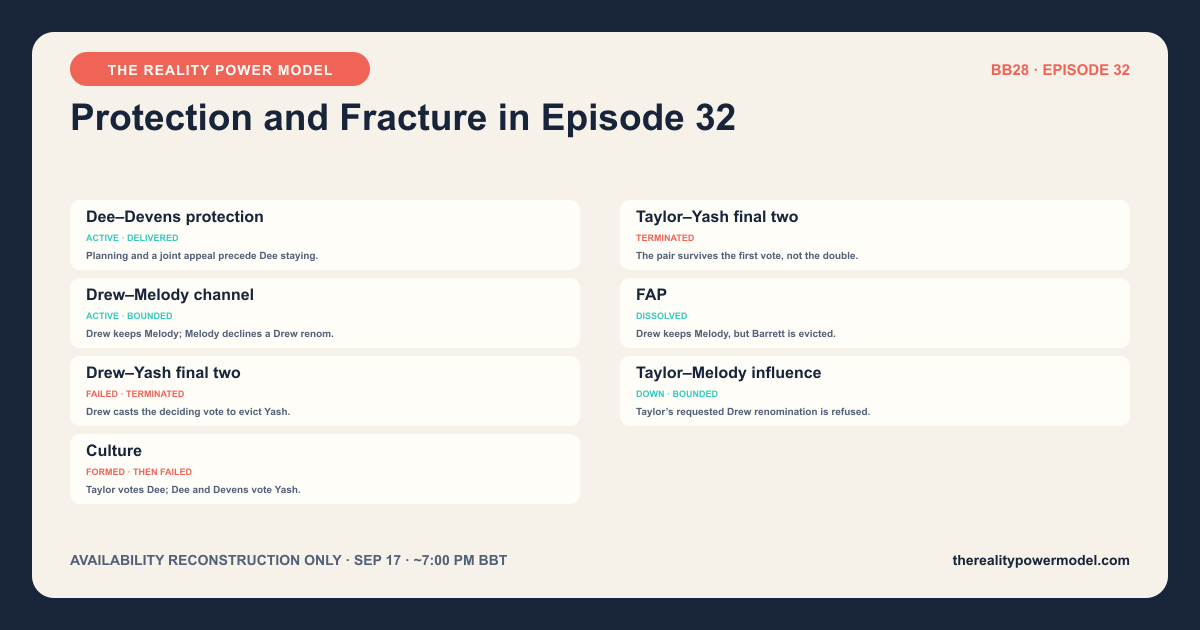
Dee–Devens is the clearest delivered reciprocal pair. Drew–Melody remains a bounded protection channel. Drew–Yash fails under a direct forced choice. Culture forms nominally and then fails its first decisive test, Taylor–Yash ends with Yash's exit, and FAP dissolves with Barrett's exit.
Protection and Fracture in Episode 32

| Relationship | Direction | Observed action or response | Limit / aftereffect |
|---|---|---|---|
| Dee ↔ Devens | Up / delivered | Credit-sharing, contingency planning, and a final joint appeal precede Drew retaining Dee. | Delivery is bounded to the recorded interval; it is not universal control. |
| Drew ↔ Melody | Up / bounded | Drew promises and casts the keep-Melody vote; Melody later refuses the Drew renomination request. | The next non-office reciprocity test remains open. |
| Drew ↔ Yash | Down / terminated | Drew casts the deciding vote to evict Yash despite their concealed final two. | The forced choice resolves against the deal. |
| Taylor ↔ Yash | Down / terminated | Taylor survives the first vote, but Yash leaves in the double eviction. | No later protection window remains available. |
| Taylor → Melody | Down / bounded | Taylor asks for Drew as replacement; Melody refuses. | The failed request does not prove total relationship collapse. |
| Dee → Drew | Up / bounded | Dee and Devens appeal for Dee's safety; Drew votes against Yash. | The edited record does not establish single-cause influence. |
| Barrett → Devens | Down | Devens hears Barrett's shield pitch and then votes to evict him. | Access and consideration are not delivered protection. |
| Group | Terminal state | Observed coordination | Limit |
|---|---|---|---|
| Dee–Devens reciprocal protection | Active / delivered | They coordinate plans and jointly retain Dee in the second eviction. | Carry only at observed terminal strength. |
| Drew–Melody protection channel | Active / bounded | Drew keeps Melody; Melody declines to renominate Drew. | Durable next-cycle protection remains untested. |
| Drew–Yash final two | Failed / terminated | Drew casts the deciding vote to evict Yash. | Prior promises do not override the delivered vote. |
| Culture | Formed then failed | Taylor votes Dee while Dee and Devens vote Yash. | Formation language is not coordinated protection. |
| Taylor–Yash final two | Terminated by Yash exit | The pair survives the first eviction, not the double. | No continuing in-game tie remains. |
| FAP | Dissolved by Barrett exit | Drew keeps Melody, but Barrett is evicted. | The three-person structure no longer exists in the active game. |
Fan Context, Not a Rating Input
The finalized Week 9 Big Brother Network Favorite Houseguest poll is retained as provider-specific nonprobability context. It allowed repeat daily voting, reported more than 9,000 votes, and has no Power Rating effect. Week 10 remained open and is excluded.
| Week 9 displayed rank | Player | Displayed share | Use here |
|---|---|---|---|
| 1 | Devens | 28.4% | Prior-week context only |
| 2 | Taylor | 24.0% | Prior-week context only |
| 3 | Dee | 13.5% | Prior-week context only |
| 4 | Yash | 10.8% | Prior-week context only |
| 5 | Drew | 7.8% | Prior-week context only |
| 6 | Melody | 5.4% | Prior-week context only |
| 7 | Angela | 5.1% | Prior-week context only |
| 8 | Barrett | 5.0% | Prior-week context only |
04
Strategy, Luck & the Game
Safety, Formal Rights, and Opportunity
All episode-specific safety locks expire by the natural terminal. The active five begin the next cycle without an Episode 32 office or safety lock. Opportunity remains distinct from Power and from the competition results that produced safety during the broadcast.
| Player | Episode 32 formal or safety event | Safety at cutoff | Final-five opportunity state | Power treatment |
|---|---|---|---|---|
| Dee | Nominated; survived Drew's deciding vote | No active lock | Retains reciprocal Devens link | No automatic score change |
| Devens | Won and used veto on himself | No active lock; veto expired | Retains broad coordination access | Temporary authority preserved at event level; total remains 19 |
| Drew | Cast both majority votes | No active lock | Retains Melody and Dee–Devens channels | Vote outcomes do not automatically change a global rating |
| Melody | Won Blockbuster and HOH; nominated Dee and Devens | No active lock; HOH expired | Retains Drew channel and Taylor conflict | Temporary office preserved at event level; total remains 10 |
| Taylor | Nominee in first eviction; minority vote in second | No active lock | Active after Culture's failure | Survival and exposure do not automatically change Power |
How the Double Eviction Reached the Final Five

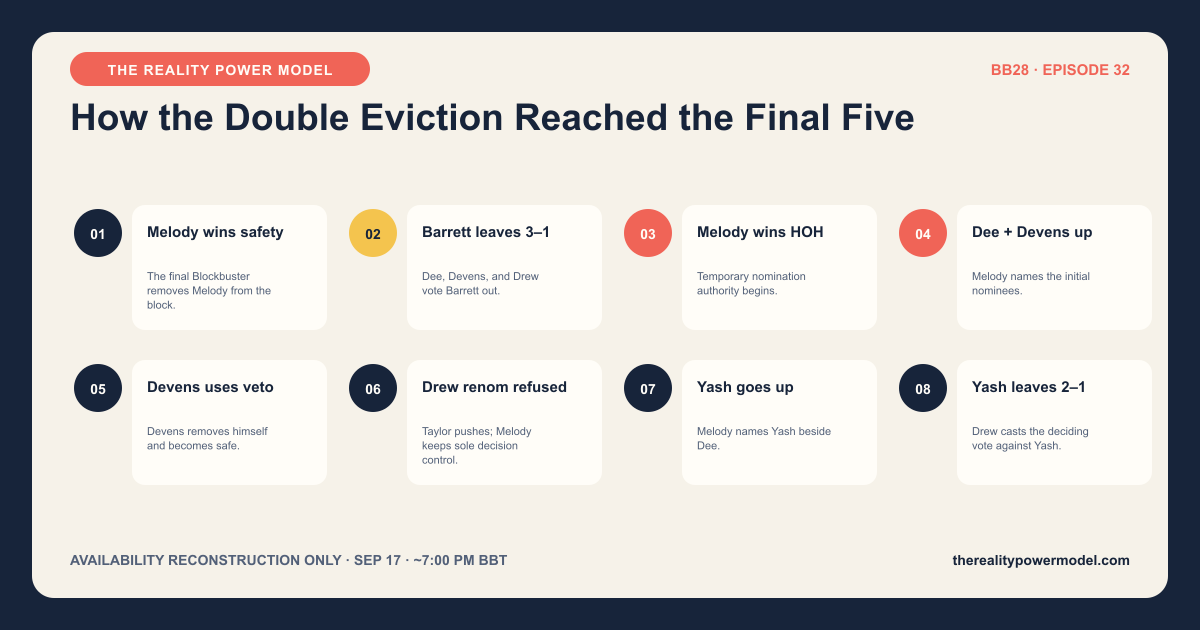
| Order | Completed event | State or response | Limit |
|---|---|---|---|
| 1 | Melody wins the final Blockbuster | Melody becomes safe; Barrett and Taylor remain nominees. | Competition safety is not a Power score. |
| 2 | Barrett is evicted 3–1 | Dee, Devens, and Drew vote Barrett out; Melody votes Taylor. | Individual ballots and majority result remain distinct. |
| 3 | Melody wins HOH | Temporary nomination authority and HOH immunity begin. | The office later expires inside the episode. |
| 4 | Dee and Devens are nominated | Both enter eviction exposure. | Exposure is not a Power Rating. |
| 5 | Devens wins and uses veto | Devens removes himself and becomes safe. | The one-use authority immediately expires. |
| 6 | Taylor requests Drew as replacement | Melody refuses and retains sole decision control. | The failed request does not establish total influence absence. |
| 7 | Melody names Yash | Yash joins Dee on the final block. | Exact broadcast minute is unavailable. |
| 8 | Yash is evicted 2–1 | Taylor votes Dee; Devens and Drew vote Yash. | Drew's ballot is decisive, but no single conversation is claimed as the cause. |
05
Analysis
Drew Delivers Two Different Protections
Drew keeps Taylor over Barrett in the first eviction, then keeps Dee over Yash in the second. The second choice terminates the concealed Drew–Yash final two while preserving Drew's access to Melody and the Dee–Devens pair. That is a clear delivered priority choice, not proof that Drew controls either remaining channel.
Dee–Devens Converts Planning into a Result
Dee and Devens share credit, map double-eviction branches, and make a final appeal to Drew. Devens removes himself with veto, and Drew's ballot retains Dee. This is bounded reciprocal delivery: it strengthens the pair's observed record without assigning single-cause control over Drew.
Taylor's Influence Meets a Limit
Taylor asks Melody to name Drew as the replacement nominee, but Melody refuses and names Yash. Taylor then votes against Dee while Dee and Devens vote against Yash. The sequence shows a failed nomination request and the collapse of Culture's coordinated-protection test; it does not establish all of Taylor's private motives or future options.
Exit Performance
| Player | Observable exit finding | Observable alternative route | Claim stop |
|---|---|---|---|
| Barrett | Reached Devens with a shield/target offer, but Devens and the majority evicted him 3–1. | A delivered commitment from Drew or Devens, or a Blockbuster win. | Does not claim the pitch caused the exit or that an unseen alternative would have worked. |
| Yash | Reached the block after Devens used veto; Drew cast the deciding vote against their prior final two. | A different replacement nominee or a delivered Drew protection vote. | Does not claim one conversation caused the result. |
06
What It Means
Episode 32 compresses two eliminations, three temporary formal powers, and a direct relationship test into one terminal snapshot. The durable result is not a broad score rewrite. Yash's HOH office expires, returning two formal ratings to baseline. Melody and Devens use decisive rights that do not persist. The field leader remains Devens, the clearest reciprocal pair is Dee–Devens, and Drew's two votes reveal split protection across the surviving field.
07
Best Moves
What the Last Best Moves Produced
Seven inherited recommendations receive bounded alignment labels. These labels compare observed conduct with prior advice; they do not prove causation or change a Power score.
| Player | Prior recommendation result | Alignment |
|---|---|---|
| Barrett | Pitched Devens and retained contact, but no protection was delivered; Barrett was evicted. | Not aligned / failed |
| Dee | Maintained Devens as the clear reciprocal partner; their joint appeal retained Dee. | Mostly aligned |
| Devens | Coordinated with Dee, won and used veto, then helped retain Dee. | Aligned / delivered |
| Drew | Protected Taylor first, then evicted Yash and retained Dee. | Aligned / priority choice observed |
| Melody | Drew kept Melody; as HOH she independently declined Taylor's Drew-renomination request. | Mostly aligned |
| Taylor | Survived the first vote, but Culture failed and Yash exited before later protection. | Partially aligned / structure failed |
| Yash | Taylor survived first; Drew then evicted Yash and Culture split. | Not aligned / conflict unresolved |
Best Moves Right Now
Five future recommendations name observable delivery tests for the active final five. They are advice, not predictions, scores, or guarantees.
| Player | Frozen Best Move Right Now | What would show it worked |
|---|---|---|
| Dee | Make the Dee–Devens priority explicit before a forced final-five choice and secure one named contingency outside the pair. | A named outside contingency delivers protection when the pair faces a direct conflict. |
| Devens | Use broad access to preserve Dee while defining a second protection path that does not depend on competition safety. | A non-competition protection path is named and delivered. |
| Drew | Clarify whether Melody or Dee–Devens has priority before the next nomination and make one reciprocal protection term explicit. | A direct conflict produces a documented choice and reciprocal action. |
| Melody | Convert the Drew channel into one non-office protection commitment while repairing or clearly bounding the Taylor conflict. | Drew delivers protection without Melody holding office, and the Taylor boundary becomes explicit. |
| Taylor | Replace the failed Culture structure with one explicitly accepted reciprocal protection arrangement before the next vote. | Another player explicitly accepts and delivers the arrangement. |
08
Things to Watch
- H39 — Dee–Devens forced choice: If they face a direct final-five conflict, does their credit-sharing agreement produce attributable reciprocal protection?
- H40 — Drew's split channels: If Drew must choose between Melody and the Dee–Devens pair, who receives the first delivered protection action?
- H41 — Melody without office: Does the Drew protection channel produce a non-competition safety benefit when Melody lacks formal authority?
- H42 — Taylor's replacement structure: After Culture's failure, does Taylor secure explicit reciprocal protection before the next nomination or vote?
These are frozen future tests, not predictions of certainty. H33 receives bounded support; H34 closes without a qualifying disclosure; H35 and H37 are not supported; H36 forms and then fails; H38 closes because a later protection window becomes untestable.
| Hypothesis | Frozen test | Episode 32 state |
|---|---|---|
| H33 | If Barrett remains a final nominee, record the keep-Taylor vote condition. | Supported / bounded; Drew votes Barrett out and keeps Taylor. |
| H34 | If Taylor or Melody learns the veto deal, record observable trust or coordination effects. | Closed; no qualifying disclosure captured. |
| H35 | If Drew and Yash face a direct conflict, record whether the final two is prioritized. | Not supported; Drew's deciding vote evicts Yash. |
| H36 | If Culture receives acceptance, record coordinated protection. | Partially supported at formation, then failed under the vote test. |
| H37 | If Barrett survives, record attributable Devens protection from the shield pitch. | Not supported; no protection is delivered and Barrett exits. |
| H38 | If Taylor survives, record later delivered Yash protection. | Closed; Yash exits before a later protection window. |
| H39 | Dee–Devens face a direct final-five conflict. | Frozen prospective / open. |
| H40 | Drew must choose between Melody and Dee–Devens. | Frozen prospective / open. |
| H41 | Melody lacks office and seeks non-competition protection from Drew. | Frozen prospective / open. |
| H42 | Taylor seeks a replacement reciprocal structure after Culture. | Frozen prospective / open. |
09
What We're Analyzing
The reconstruction contains 31 consequential events from 11 sources, 31 complete response-first scans across the six Power bases, 31 primary Power Effects, 48 player/base transitions, 12 dyad observations, 15 alliance-member rows, 38 hypothesis records, 12 opportunity assessments, two exit-performance records, two exit records, and 215 claim-crosswalk rows. Selective observation, invisible private conduct, source mutability, and exact within-broadcast timing remain live limitations.
| Frozen presentation | Record count | Reader boundary |
|---|---|---|
| Consequential event ledger | 31 | Six later or supplemental items excluded |
| Six-Power scans / primary effects | 31 / 31 | Response-first; no score by result alone |
| Component transitions | 48 | Two Yash components changed; 46 retained |
| Dyads / group-member records | 12 / 15 | Tie, group, proposal, and delivery grain retained |
| Hypotheses / opportunity assessments | 38 / 12 | H39–H42 frozen before future evidence |
| Prior / prospective Best Moves | 7 / 5 | Advice is not Power or causal proof |
| Exit-performance / exit records | 2 / 2 | Alternatives remain non-causal and bounded |
| Sources / gaps and controls | 11 / 8 | Two missing windows and timing limits retained |
| Technical claim crosswalk | 215 | Every public claim remains bound |
What the Episode 32 Reconstruction Covers

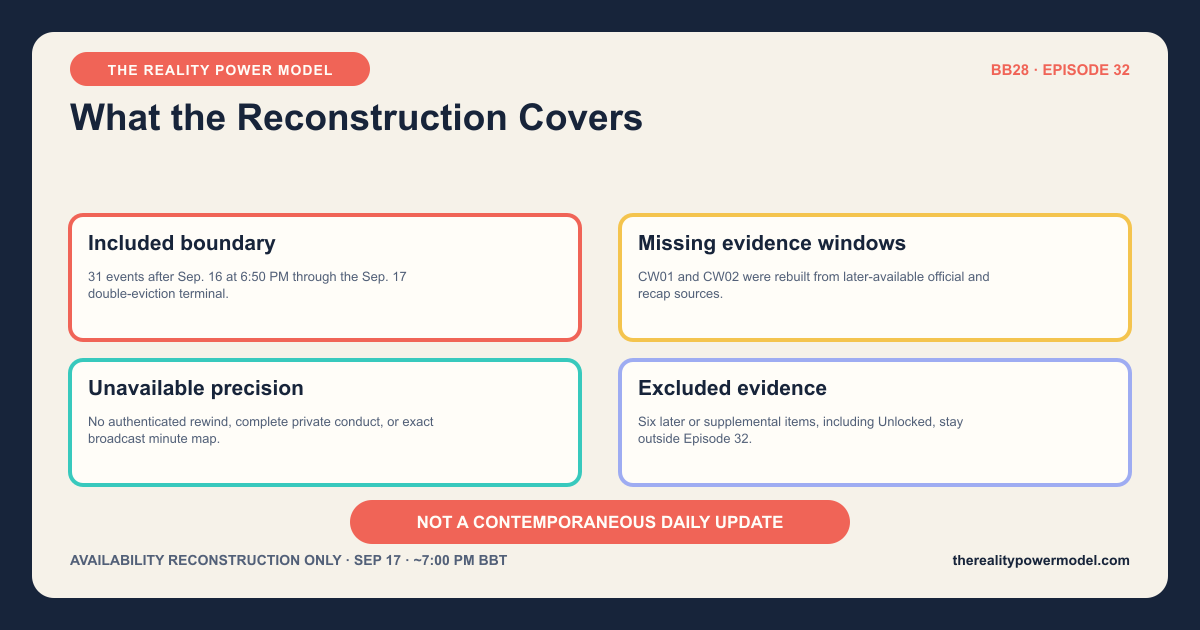
| Boundary field | Exact state |
|---|---|
| Included interval | Strictly after Sep. 16 at 6:50 PM through Sep. 17 at approximately 7:00 PM BBT reconstructed |
| Included events | 31 consequential events |
| Missing evidence windows | CW01 and CW02 |
| First stable post-terminal feed return | Sep. 17 at 7:07 PM BBT; boundary evidence only |
| Excluded later or supplemental items | Six, including every 7:07 PM+ feed event and the Sep. 18 Big Brother Unlocked installment |
| Daily Update | Not claimed; this is a later reconstruction |
| Remaining unknowns | Authenticated rewind, complete private conduct, exact source-publication minutes, exact within-broadcast event minutes |
10
Full Episode Data
The accessible tables above expose the formal results, every active Player's six Power Ratings, terminal juror context, both changed Yash components, temporary authority duration, the double-eviction sequence, relationships and groups, provider-specific poll limits, opportunity and safety states, prior and prospective Best Moves, exit analysis, hypotheses, and the evidence boundary. The frozen technical package retains the complete 31-event ledger, 31 six-Power scans, 31 primary effects, 48 component transitions, 12 dyads, 15 alliance-member rows, 38 hypotheses, 12 opportunity records, two exit-performance records, two exit records, 11-source registry, eight gap/control rows, and all 215 uniquely bound technical claims.
Excluded After This Cutoff
All game evidence beginning with the September 17 7:07 PM BBT feed return belongs to the next cycle. The September 18 Big Brother Unlocked installment is a supplemental official episode and is not imported into this regular game cycle. The Week 10 popularity poll remained open. This page does not infer excluded events from later evidence.