Episode 17 · Power brief
LaTrice names three nominees. Taylor’s influence stays hidden.
Haley, Chuk, and Barrett hit the block. Taylor’s earlier push becomes the Chuk nomination while Chuk still doubts her influence over LaTrice. The old Toolshed structure breaks apart, and the record stops before anyone plays for the veto.
Always on the page
Power snapshot
Terminal: Ashley remains terminal at 7. Rome and Jason remain terminal at 8. Lyric remains terminal at 13. All four are excluded from the active ranking.
Naming three nominees activates the broad consequences attached to HOH.
Chuk reaches the block after her push and still underestimates her role.
His support stays concentrated around Haley and does not change LaTrice’s decision.
Episode action sequence
LaTrice makes the nominations. The hidden influence behind one name survives the reveal.
- 1LaTrice names three
Haley, Chuk, and Barrett face formal danger
- 2Mallory loses the challenge
She chooses Melody for a forced tether
- 3Taylor and Kamu conceal
They present the nomination result as a surprise
- 4Chuk challenges LaTrice
The reversal attempt fails as he doubts Taylor’s sway
- 5Toolshed dissolves
The old structure ends before veto day begins
What changes
LaTrice uses her HOH power. Taylor gains information; Chuk loses trust.
LaTrice’s Coercive Power rises 1 → 4 when the nominations create immediate danger, while Referent falls 3 → 2 as trust narrows. Taylor’s Informational Power rises 3 → 4 after the Chuk result converts and stays under-attributed. Chuk’s Referent Power falls 3 → 2 after expected protection and his reversal attempt fail.
The influence no one names
Taylor gets the outcome. Chuk helps keep her role out of view.
- Taylor makes the earlier pushShe gives LaTrice a reason to include Chuk
- LaTrice makes the choiceChuk becomes one of three nominees
- Taylor preserves distanceShe presents the result as a surprise
- Chuk misreads the sourceHe still believes Taylor has little sway with LaTrice
The Chuk nomination supplies Taylor’s first prospective low-attribution test. It passes once: her information changes a consequential decision while the target does not assign her full credit. One result is not enough to prove durability.
Claim stop: Episode 17 establishes the three nominations, the first Taylor influence test, the forced Mallory–Melody tether, and Toolshed’s dissolution. It excludes veto selection, competition, use, and every Episode 18 or later event.
Always on the page
Where this Episode sits in the season
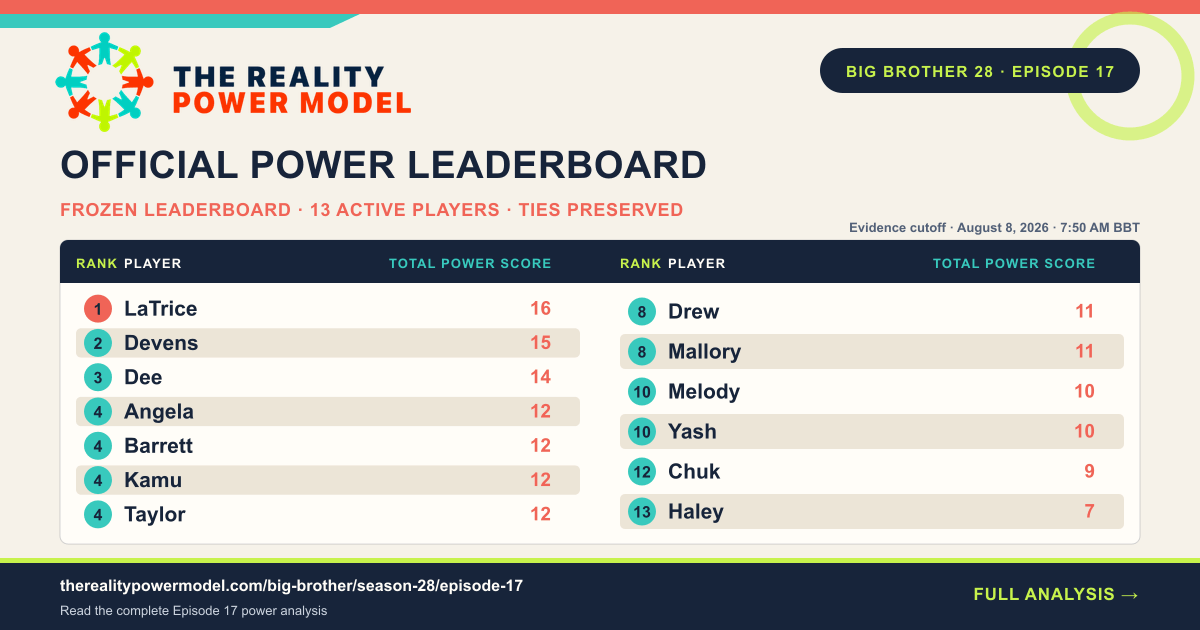
The frame stays consistent. The values show only what is established through Episode 17.The block changes their danger, but nomination alone does not rewrite a six-base Power score.
The Chuk result converts while her role remains underestimated.
The declaration matches accumulated breakdowns in coordination and protection.
The checkpoint is non-retrospective, but every individual score record is outside the prospective accuracy set.
The people inside the numbers
Players in this Power story
Featured cards are limited to the strongest Episode-level Power changes, uses, responses, or closures.
HOH · Rank 1
LaTrice Verrett
57 · Maplewood, New Jersey · Boutique salesperson
LaTrice makes the nominations and loses Chuk’s trust.
LaTrice holds at 10 through Episode 15, then rises to 14 with HOH and a protection exchange. Episode 17 activates the office’s consequences and moves her to first, even as the nominations narrow trust around her.
Power profile
- Legitimate
- 4
- Reward
- 2
- Coercive
- 4
- Expert
- 2
- Referent
- 2
- Informational
- 2
Season Power
Episode checkpoints- Start
- 9
- Peak
- 16
- Current
- 16
- Episodes 3–15 · Holds at 10
- Episode 16 · Rises to 14
- Episode 17 · Rises to 16
- Episode position
- HOH placing the first Week 5 nominees on the block.
- What they do
- Nominates Haley, Chuk, and Barrett after weighing several advisers and then defends the rationale to Chuk.
- Result
- The nominations take effect. Chuk does not reverse the decision, and trust with part of his network weakens.
- Power change
- Total Power rises 14 → 16 as Coercive moves 1 → 4 and Referent falls 3 → 2.

Active · Rank 4
Taylor Brown
27 · Deerfield Beach, Florida · Elementary school counselor
Taylor’s push reaches the block while the target discounts her role.
Taylor reaches 11 in Episode 3 and stays there through Episode 16. The next result crosses the threshold: LaTrice nominates Chuk after Taylor’s push, and Chuk still believes Taylor lacks influence.
Power profile
- Legitimate
- 1
- Reward
- 1
- Coercive
- 1
- Expert
- 2
- Referent
- 3
- Informational
- 4
Season Power
Episode checkpoints- Start
- 9
- Peak
- 12
- Current
- 12
- Episodes 1–2 · Holds at 9
- Episodes 3–16 · Holds at 11
- Episode 17 · Rises to 12
- Episode position
- Low-attribution adviser whose earlier target work becomes an official nomination.
- What they do
- Keeps distance from the result after helping move LaTrice toward Chuk.
- Result
- Chuk reaches the block and continues to underestimate Taylor’s influence.
- Power change
- Total Power rises 11 → 12 as Informational moves 3 → 4. The first prospective test passes; durability stays open.

Nominated · Rank 12
Chuk Anyanwu
27 · Dallas, Texas · Supply chain analyst
Chuk expects protection, but LaTrice nominates him.
Chuk reaches 11 when early relationships deepen and holds there through Episode 14. The hidden vote reduces his reward reach, and Episode 17 exposes a second limit when expected protection and his appeal to LaTrice both fail.
Power profile
- Legitimate
- 1
- Reward
- 1
- Coercive
- 1
- Expert
- 2
- Referent
- 2
- Informational
- 2
Season Power
Episode checkpoints- Start
- 9
- Peak
- 11
- Current
- 9
- Episodes 3–14 · Holds at 11
- Episode 15 · Falls to 10
- Episode 17 · Falls to 9
- Episode position
- Nominee relying on Haley and a narrower network for protection.
- What they do
- Challenges LaTrice’s rationale and tries to reverse the nomination while treating Taylor as a weak influence.
- Result
- LaTrice holds the decision. Chuk’s remaining support is real but concentrated.
- Power change
- Total Power falls 10 → 9 as Referent moves 3 → 2. The nomination itself adds no automatic loss.

Nominated · Rank 13
Haley Thogmartin
29 · Wildwood, Missouri · Telemedicine executive
Haley reaches the block with the same inaccurate vote map.
Haley peaks at 16 with HOH, then falls to 7 when the office expires and the hidden vote exposes broader failures. Episode 17 increases her danger without adding another score penalty for the same information problem.
Power profile
- Legitimate
- 1
- Reward
- 1
- Coercive
- 1
- Expert
- 1
- Referent
- 2
- Informational
- 1
Season Power
Episode checkpoints- Start
- 9
- Peak
- 16
- Current
- 7
- Episode 13 · Peaks at 16
- Episode 15 · Falls to 7
- Episodes 16–17 · Holds at 7
- Episode position
- Primary target entering the veto window with Chuk beside her.
- What they do
- Continues reconstructing the Lyric vote inaccurately and considers protecting the nominations even if veto becomes available.
- Result
- Haley remains nominated. The existing low information score already contains the repeated failure.
- Power change
- Total Power holds at 7. Nomination danger does not create an automatic Power loss.

Forced tether · Rank 8
Mallory Aurichio
24 · Township of Washington, New Jersey · Rocket scientist
Mallory loses the Time Capsule challenge and chooses Melody for the tether.
Mallory peaks at 13 with opening veto control, later settles at 12, and moves to 11 after temporary authority and one information channel close. The Episode 17 tether changes her movement and proximity, not her voluntary relationship power.
Power profile
- Legitimate
- 1
- Reward
- 2
- Coercive
- 1
- Expert
- 2
- Referent
- 3
- Informational
- 2
Season Power
Episode checkpoints- Start
- 9
- Peak
- 13
- Current
- 11
- Episode 3 · Peaks at 13
- Episodes 6–14 · Holds at 12
- Episodes 15–17 · Holds at 11
- Episode position
- Time Capsule participant required to select another player for a 48-hour tether.
- What they do
- Loses the challenge and chooses Melody to share the production-imposed condition.
- Result
- Mallory and Melody become tethered. Forced proximity supplies no voluntary Referent evidence.
- Power change
- Total Power holds at 11. The punishment changes structure, not the six demonstrated influence ratings.
Cast details: Paramount+ official Season 28 cast guide. Official cast portraits: Evan Mulling / CBS. Episode analysis: S28E17 Technical Episode Report v1.
Always on the page