Episode 25 · Power brief
Drew wins safety. Mallory loses her best chance to stay.
Barrett lines up five conditional votes against Drew. Then Drew wins the Blockbuster and removes that matchup. With Taylor beside her, Mallory keeps only Barrett and Melody; six other voters evict her. Dee’s preferred target leaves as her HOH authority ends.
Always on the page
Power snapshot
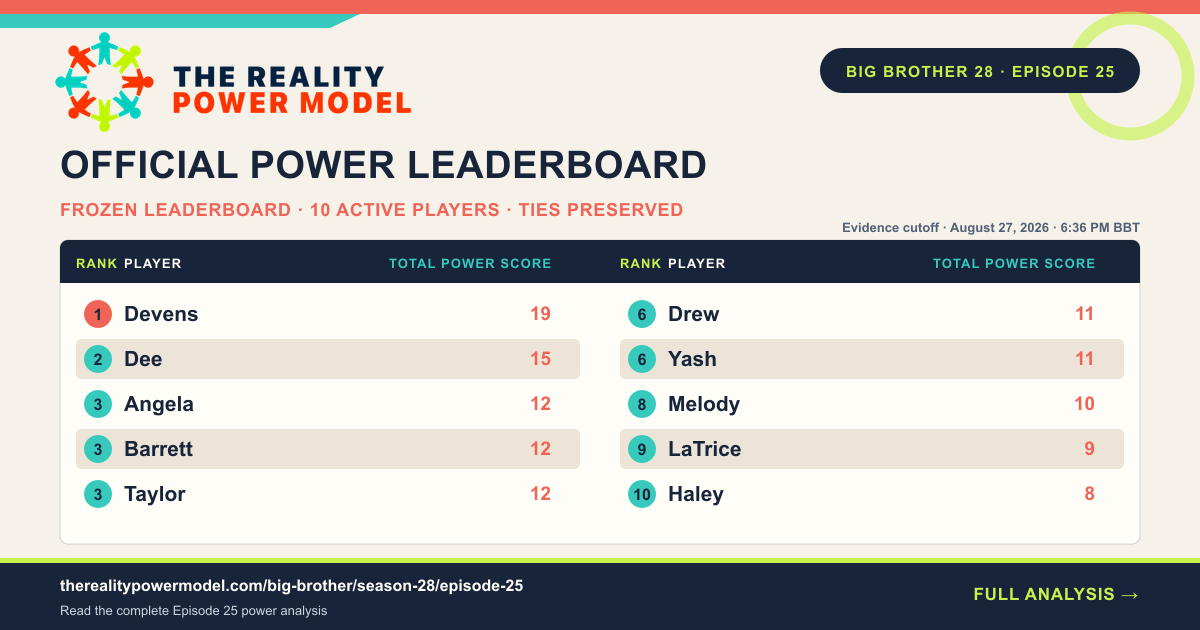
Terminal: Ashley remains terminal at 7. Rome and Jason remain terminal at 8. Lyric remains terminal at 13. Chuk remains terminal at 9. Kamu remains terminal at 12. Mallory becomes terminal at 11. All seven are excluded from the active ranking.
Yash, LaTrice, Taylor, Melody, and Mallory accept the conditional route against Drew. Drew does not.
Blockbuster safety removes him from danger and erases the matchup Barrett’s coalition prepares to use. It does not give Drew control of the votes.
Barrett and Melody act on their promises. The relationship power is real even though it is too narrow to save her against Taylor.
Episode action sequence
Barrett lines up five votes against Drew. Drew wins safety and changes the matchup.
- 1Dee’s core conceals the target
Mallory’s side temporarily accepts that Taylor will leave
- 2The plan becomes public
Haley reveals it and Barrett refuses to vote Mallory out
- 3Barrett lines up five conditional votes
The route exists only if Drew remains vulnerable
- 4Drew wins the Blockbuster
Mallory faces Taylor instead of Drew
- 5Six voters choose Mallory
Barrett and Melody cast the two votes against Taylor
What changes
Dee’s office expires. Her social and informational ratings remain.
The Week 7 cycle ends, so Dee’s Legitimate and Coercive Power each return from 4 → 1. Reward3, Expert3, Referent3, and Informational4 carry. Mallory becomes terminal at 11; every other active six-base score holds.
Why Mallory leaves
Her best plan works only if Drew stays vulnerable. He does not.
- Barrett gathers a conditional fiveThe group is prepared to evict Drew in the available matchup
- Drew refuses the proposed throwBarrett’s advice does not move the person at the center of the plan
- Drew wins direct safetyThe game removes him from the vote and leaves Mallory beside Taylor
- The protection does not transferOnly Barrett and Melody keep Mallory in the new matchup
The five-vote route is credible but never reaches execution. Drew’s competition result changes the structure before the vote. The 6–2 outcome shows that Mallory’s strongest protection is matchup-specific, not that the earlier route is false or guaranteed.
Claim stop: Episode 25 establishes the campaign, the exposed target, Barrett’s conditional coalition, Drew’s Blockbuster win, the 6–2 vote, Mallory’s terminal profile, and the expiration of Week 7 authority and safety. It excludes the later reaction, Week 8 twist and HOH state, post-eviction interviews, and every Episode 26 or later event.
Always on the page
Where this Episode sits in the season
The frame stays consistent. The values show only what is established through Episode 25.The coalition is usable for one matchup and cannot act after Drew wins safety.
Barrett and Melody confirm her relationship reach even as the broader vote fails.
Formal nomination authority ends; four persistent social and informational ratings carry.
Repeat voting and incomplete shares make this a public-opinion measure, not in-house Power.
The people inside the numbers
Players in this Power story
Featured cards are limited to the strongest Episode-level Power changes, uses, responses, or closures.
Coalition builder · Rank 3
Barrett Pfeiffer
27 · Austin, Texas · Jumbotron engineer
Barrett lines up five possible votes against Drew and votes to keep Mallory.
Barrett rises from 9 to 12 in the opening stretch and holds there through shifting alliances. Episode 25 shows why: his information organizes a usable coalition and his loyalty produces a vote, while Drew’s rejection and the changed matchup reveal the limits.
Power profile
- Legitimate
- 1
- Reward
- 2
- Coercive
- 1
- Expert
- 2
- Referent
- 3
- Informational
- 3
Season Power
Episode checkpoints- Start
- 9
- Peak
- 12
- Current
- 12
- Episodes 1–2 · Holds at 9
- Episode 4 · Rises to 12
- Episodes 4–25 · Holds at 12
- Episode position
- Mallory protector and organizer of the conditional anti-Drew vote.
- What they do
- Rejects Dee’s target, coordinates five conditional votes, asks Drew to throw the Blockbuster, and votes against Taylor.
- Result
- The coalition cannot act after Drew becomes safe. Barrett and Melody still deliver the votes they promise Mallory.
- Power change
- Total Power holds at 12. Informational3 and Referent3 receive strong support, while shared incentives and Drew’s nonresponse block higher thresholds.

Blockbuster safety · Rank 6
Drew Campbell
22 · Temecula, California · Surgical dental assistant
Drew ignores Barrett’s advice, wins safety, and escapes the vote.
Drew reaches 12 through early information and relationships, then settles at 11 when one channel narrows. Episode 25 gives him decisive competition safety while the damaged Barrett and Melody ties show why safety and social protection remain separate.
Power profile
- Legitimate
- 1
- Reward
- 2
- Coercive
- 1
- Expert
- 2
- Referent
- 2
- Informational
- 3
Season Power
Episode checkpoints- Start
- 9
- Peak
- 12
- Current
- 11
- Episodes 5–13 · Holds at 12
- Episode 14 · Falls to 11
- Episodes 14–25 · Holds at 11
- Episode position
- Final nominee targeted by a conditional coalition before the Blockbuster.
- What they do
- Accepts Dee’s Mallory plan, refuses to throw the competition, and wins direct safety.
- Result
- The anti-Drew matchup disappears. Drew votes Mallory out after Barrett and Melody organize against him.
- Power change
- Total Power holds at 11. The win changes structural safety, not authority over another voter or a social Power rating.

Evicted · Terminal at 11
Mallory Aurichio
24 · Township of Washington, New Jersey · Rocket scientist
Mallory receives two promised votes and loses when the matchup changes.
Mallory peaks at 13 with opening veto control, settles at 12, and later reaches 11 when temporary authority and one information channel close. Episode 25 preserves that profile as two bonds deliver protection but six voters choose Taylor.
Power profile
- Legitimate
- 1
- Reward
- 2
- Coercive
- 1
- Expert
- 2
- Referent
- 3
- Informational
- 2
Season Power
Episode checkpoints- Start
- 9
- Peak
- 13
- Final
- 11
- Episode 3 · Peaks at 13
- Episodes 6–14 · Holds at 12
- Episodes 15–25 · Holds at 11
- Episode position
- Replacement nominee campaigning across two possible final matchups.
- What they do
- Makes direct appeals, offers future protection, and works with Barrett and Melody on the conditional Drew-out route.
- Result
- Drew wins safety. Barrett and Melody vote to keep Mallory, while six others evict her over Taylor.
- Power change
- Mallory becomes terminal at 11. Two delivered votes support Referent3; eviction does not erase demonstrated influence.

Former HOH · Rank 2
Dee Valladares
Miami, Florida · Survivor 45 winner · Survivor 50
Dee’s preferred target goes home, but the six-vote majority is not hers alone.
Dee reaches 19 during the opening HOH, settles at 13 after that office expires, and peaks at 21 in Week 7. Episode 25 returns her to 15 when the formal authority ends while reward, expertise, relationships, and information remain.
Power profile
- Legitimate
- 1
- Reward
- 3
- Coercive
- 1
- Expert
- 3
- Referent
- 3
- Informational
- 4
Season Power
Episode checkpoints- Start
- 9
- Peak
- 21
- Current
- 15
- Episode 4 · Reaches 19
- Episodes 23–24 · Peaks at 21
- Episode 25 · Falls to 15
- Episode position
- Outgoing HOH whose group keeps Mallory as the preferred target.
- What they do
- Conceals the target, explains the plan after it leaks, rejects a cover vote, and maintains the Mallory preference.
- Result
- Mallory leaves 6–2. Mixed voter motives and outside relationships prevent a claim that Dee controls all six votes.
- Power change
- Total Power falls 21 → 15 as Legitimate and Coercive each return from 4 → 1 when the Week 7 office expires.

Target frame · Rank 1
Rick Devens
Macon, Georgia · Father and former news anchor · Survivor 38 and 50
Devens keeps arguing that Mallory is the bigger threat.
Devens peaks at 20 during his first HOH cycle, holds at 15 after that office expires, and returns to 19 with the Diamond Veto. Episode 25 supplies another accepted risk comparison while independent alliance and matchup motives keep the causal claim bounded.
Power profile
- Legitimate
- 2
- Reward
- 3
- Coercive
- 4
- Expert
- 3
- Referent
- 3
- Informational
- 4
Season Power
Episode checkpoints- Start
- 9
- Peak
- 20
- Current
- 19
- Episodes 6–7 · Peaks at 20
- Episodes 8–20 · Holds at 15
- Episodes 21–25 · Holds at 19
- Episode position
- Strategic voice inside the majority targeting Mallory.
- What they do
- Explains the Mallory threat comparison and keeps his vote on her after the target becomes public.
- Result
- Players in Dee’s core use the comparison and vote Mallory out. Their own alliance and matchup interests also matter.
- Power change
- Total Power holds at 19. The response supports Expert3 and Informational4 without establishing sole control or broader Expert4 deference.
Cast details: Paramount+ official Season 28 cast guide. Official cast portraits: Evan Mulling / CBS. Episode analysis: S28E25 Technical Episode Report v3.
Always on the page