Power Analysis Episode 3
Dee Takes Control as Alliances and Information Separate the House
Dee used Legitimate and Coercive Power to nominate Yash, Taylor, and Mallory, while The Crossovers and Red Corner gave her relationship and information channels across the house. Mallory’s veto win created narrow Legitimate and Reward Power because she controlled a guaranteed protection decision. Barrett, Devens, Drew, and Taylor also used Informational Power when their reports and coordination changed shared planning.
01
Episode at a Glance
The First HOH, Nominations, Alliances, and Veto Reshape the House
After Episode 2 ended with the HOH unresolved, the result became available: Dee won HOH, and her support team became Have-Nots. Dee nominated Yash, Taylor, and Mallory. Yash felt blindsided because an earlier safety assurance had not protected him, while Taylor repaired enough trust with Dee to discuss targets and votes.
The Crossovers formed around Dee, Devens, Angela, Drew, and Barrett. Red Corner formed around Dee, Devens, Kamu, Chuk, and Haley, but Dee and Devens treated it more as a game tool than the other members did. Chuk and Kamu also locked in a strong duo. Outside those structures, Lyric and Rome became visibly close, LaTrice and Taylor coordinated repeatedly, and several players built overlapping trust networks.
Mallory won the veto. She had not used it by the cutoff, so she controlled a guaranteed self-protection option without yet receiving a Safety Lock. Ashley emerged as the likely replacement, campaigned to Dee, and received support from several players. The episode froze before the veto ceremony and final nominee set.
02
Power
Key Episode 3 Power Evidence
These are the clearest and most consequential examples of power demonstrated during Episode 3—not a complete list of every observed or attempted use. Visit the individual player pages for each player’s full power profile, supporting evidence, and changes over time.
| Power | Clearest Use and Response | Why It Mattered and Where It Stopped | Rating Effect |
|---|---|---|---|
| Legitimate Power | Dee nominated Yash, Taylor, and Mallory as HOH; Mallory controlled the live veto. | Dee’s office structured the week, while Mallory held one narrow decision. Both forms depended on temporary roles or resources. | Dee 1 → 4; Mallory 1 → 3. |
| Reward Power | Dee protected Barrett and made safety assurances; Mallory could deliver veto protection; Chuk and Rome offered limited help. | Benefits produced access, trust, or protection, but each had limited reach. | Dee, Mallory, Chuk, Rome, and Melody rose to 2. |
| Coercive Power | Dee’s nominations imposed immediate danger on three players. | The house had to respond to a credible formal consequence. It belonged to the HOH cycle. | Dee 1 → 4. |
| Expert Power | Dee accepted Angela’s guidance, and Rome received strategic advice from Devens. | The responses made their judgment relevant, but repetition was insufficient for Expert Power 3. | Rating stayed the same. |
| Referent Power | Confirmed alliances, explicit trust, protection, and repeated coordination produced several voluntary responses. | The evidence created meaningful networks without proving whole-house loyalty or future durability. | Multiple players rose from 2 → 3. |
| Informational Power | Dee, Barrett, Devens, Drew, and Taylor used reports, disclosure, information-sharing role, or vote coordination that changed planning. | Information moved decisions inside several networks, but not every player accepted every source. | Each reached Informational Power 3. |
Legitimate Power
Dee could nominate and later name a replacement because she was HOH. Mallory could decide how to use the live veto. Their authority differed in scope and would expire at different points.
Reward Power
Protection offers mattered when another player accepted them or gained real safety access. Broken or untested assurances limited how much credit they received.
Coercive Power
Dee’s nominees faced a formal consequence backed by the game rules. No other player had comparable consequence power.
Expert Power
Angela and Devens each produced limited advice responses. The episode did not show repeated players following that judgment across multiple players.
Referent Power
The first durable-looking networks emerged through The Crossovers, Red Corner, the Chuk–Kamu Duo, and several strong dyads. Negative ties remained visible alongside those gains.
Informational Power
Information began changing target understanding, replacement planning, and vote coordination. Barrett, Devens, Drew, Taylor, and Dee showed the clearest repeated examples.
Current Power Leaderboard
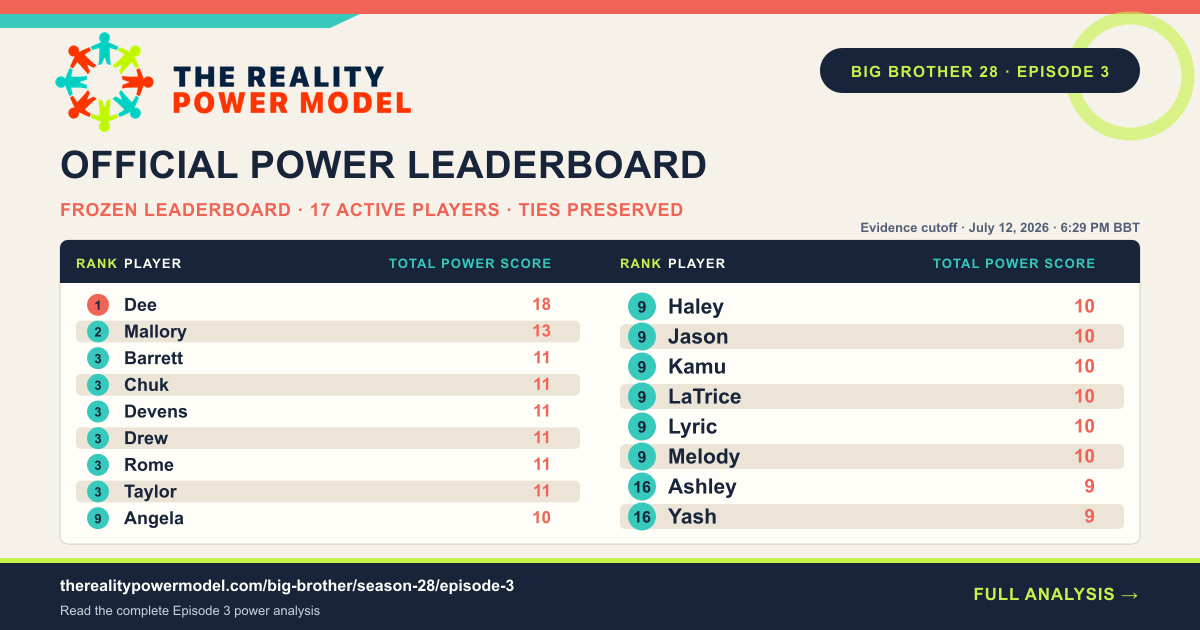
The Total Power Score is the sum of six current ratings, each scored from 1 to 4. With seventeen players active, this display shows five top entries and five bottom entries. Standard competition ranks are used; players with the same score share the same rank. Roster order only determines which tied entries appear when a tie crosses the display cutoff.
| Group | Rank | Player | Total Power Score |
|---|---|---|---|
| Top | 1 | Dee | 18 |
| Top | 2 | Mallory | 13 |
| Top | 3 | Barrett | 11 |
| Top | 3 | Chuk | 11 |
| Top | 3 | Devens | 11 |
| Bottom | 9 | Angela | 10 |
| Bottom | 9 | Haley | 10 |
| Bottom | 9 | Jason | 10 |
| Bottom | 16 | Ashley | 9 |
| Bottom | 16 | Yash | 9 |
Players omitted at a tied cutoff are not ranked below the displayed players with the same score.
Dee Leads With Formal Authority and a Working Network
Dee’s HOH gives her the only broad current Legitimate and Coercive Power. Her protection and information channels also produce voluntary responses, although Yash and Kamu show where trust has been damaged.
Mallory Controls Her Own Safety
Mallory’s live veto gives her narrow authority and a guaranteed protection option. Those powers will expire when she uses the veto.
Barrett Becomes a Protected Information Partner
Dee uses Barrett’s reports, includes him in vote planning, and keeps him out of replacement danger.
Chuk Builds a Strong Duo and Wider Working Ties
Kamu commits to Chuk, Rome agrees to work with him, and Chuk can offer limited protection.
Devens Connects Alliance Structures
Devens uses Red Corner information inside The Crossovers and coordinates with Angela and Rome. The same information-sharing role creates trust risk.
Episode 3 Power Shifts
Dee’s Total Power Score Rises by 9 Because HOH Authority and Network Influence Activate
Total Power Score: 9 → 18
Why: Dee wins HOH, nominates three players, protects Barrett, and coordinates through overlapping alliances.
What Changed: Legitimate Power 1 → 4; Reward Power 1 → 2; Coercive Power 1 → 4; Referent Power 2 → 3; Informational Power 2 → 3.
What Stayed the Same: Expert Power remained 2.
Why It Matters: Dee can force formal responses and also receive voluntary information and cooperation. The office will expire, and damaged trust with Yash and Kamu could outlast it.
Mallory’s Total Power Score Rises by 4 Because She Controls the Live Veto
Total Power Score: 9 → 13
Why: Mallory wins a resource that can guarantee her safety and holds several trusted relationships.
What Changed: Legitimate Power 1 → 3; Reward Power 1 → 2; Referent Power 2 → 3.
What Stayed the Same: Coercive Power 1, Expert Power 2, and Informational Power 2.
Why It Matters: Mallory can protect herself without depending on a vote. The formal resource is temporary, while her relationships must carry her after it expires.
Barrett, Chuk, Devens, Drew, Rome, and Taylor Each Rise by 2 as Relationships, Benefits, or Information Produce Responses
The remaining Episode 3 changes are summarized here; each Player page preserves the full before-and-after explanation and every unchanged power.
| Player | Total Power Score | What Changed | Why It Mattered and Where It Stopped |
|---|---|---|---|
| Barrett | 9 → 11 | Referent Power 2 → 3; Informational Power 2 → 3 | Dee used his reports and protected him, with the clearest reach inside The Crossovers. |
| Chuk | 9 → 11 | Reward Power 1 → 2; Referent Power 2 → 3 | Kamu committed to him and he could offer limited help; eviction effectiveness remained untested. |
| Devens | 9 → 11 | Referent Power 2 → 3; Informational Power 2 → 3 | Alliance disclosure and coordination changed allies’ understanding, while Lyric and Taylor remained limits. |
| Drew | 9 → 11 | Referent Power 2 → 3; Informational Power 2 → 3 | Multiple players trusted his information-sharing role, but a vote had not yet tested the network. |
| Rome | 9 → 11 | Reward Power 1 → 2; Referent Power 2 → 3 | Assistance and a broad trust circle gave him options without formal control. |
| Taylor | 9 → 11 | Referent Power 2 → 3; Informational Power 2 → 3 | Repaired trust and vote coordination changed planning, but votes had not yet been delivered. |
| Angela | 9 → 10 | Referent Power 2 → 3 | Several players treated her as a trusted connection; Expert evidence remained limited. |
| Haley | 9 → 10 | Referent Power 2 → 3 | Red Corner provided an accepted alliance base with hidden commitment risk. |
| Jason | 9 → 10 | Referent Power 2 → 3 | Angela, Lyric, and Rome placed him in trusted relationships that had not yet coordinated a vote. |
| Kamu | 9 → 10 | Referent Power 2 → 3 | The Chuk duo and Red Corner supplied voluntary support with uneven alliance risk. |
| LaTrice | 9 → 10 | Referent Power 2 → 3 | Taylor repeatedly coordinated with her, and Rome included her in his inner circle. |
| Lyric | 9 → 10 | Referent Power 2 → 3 | A concentrated trust network formed around Rome, Jason, Mallory, and Yash. |
| Melody | 9 → 10 | Reward Power 1 → 2 | Limited advice and help had value, but broad protection had not formed. |
03
Relationships
Most Significant Relationships
Strengthened
Dee ↔ Barrett
Barrett reported information and counted votes with Dee; Dee protected him from replacement consideration. The relationship produced both Informational and Referent Power.
Strengthened
Chuk ↔ Kamu
The pair explicitly locked in a duo. The commitment gave each a clear voluntary partner, but voting effectiveness remained untested.
Strengthened
LaTrice ↔ Taylor
They repeatedly coordinated targets and replacement ideas and agreed on a shared timing strategy. The relationship mattered because it changed planning under nomination pressure.
Concentrated
Lyric ↔ Rome, Jason, and Mallory
Lyric placed unusual trust in a small circle, especially Rome. The network provided relationship strength while making her associations visible.
Weakened
Yash → Dee
Yash’s nomination contradicted an earlier safety assurance, leaving him blindsided. Dee’s authority worked, but the broken promise reduced trust.
Most Significant Alliances and Voting Groups
The Crossovers · Confirmed and Active
Members: Dee, Devens, Angela, Drew, and Barrett
Members accepted the group and coordinated early strategy. Its existence was clear, but no eviction had yet tested whether all five would act together.
Red Corner · Confirmed but Asymmetric
Members: Dee, Devens, Kamu, Chuk, and Haley
Kamu, Chuk, and Haley treated the alliance as genuine. Dee and Devens treated it as a way to control information, creating a hidden commitment gap.
Chuk–Kamu Duo · Confirmed and Strong
Members: Chuk and Kamu
The pair explicitly committed and coordinated. The next test was whether either would accept risk to protect the other.
04
Strategy & Luck
Performance, Safety, Structure, and Chance
Dee’s HOH win activated safety and formal authority. Mallory’s veto win created a guaranteed way to save herself, but her Safety Lock had not activated before use. Rome, Chuk, and Jason retained premiere Safety Locks. The nominees and veto draw shaped who could control safety, while Have-Not status changed living conditions. Time Capsule voting remained open with no known recipient or result. These factors changed opportunity and pressure without acting as automatic power scores.
05
Analysis
Why Did the First Real Power Hierarchy Appear?
Episodes 1 and 2 had nearly no score separation because the house had not produced enough observable responses. Episode 3 added formal decisions, alliances, protection, information information-sharing role, and repeated trust. Dee’s nominees had to respond to her office. Barrett, Angela, Devens, and Drew coordinated inside The Crossovers. Chuk and Kamu committed to each other. Taylor and LaTrice repeatedly planned together. Mallory gained a veto resource that could guarantee safety.
The hierarchy is still provisional. Dee’s largest gains depend partly on an HOH office that will expire. Red Corner contains a hidden commitment gap. Mallory’s formal power will end when the veto is used. Several new relationship ratings have not yet survived an eviction vote.
Bottom Line: The first separation comes from observable responses, not visibility alone. Formal authority, protection, trust, and information now change player behavior, but the next ceremony and vote will reveal which parts are temporary and which are durable.
06
Best Moves
Dee
Best Move Right Now: Choose a replacement nominee who creates the least trust damage while preserving The Crossovers.
What Would Show It Worked: The alliance stays coordinated and the replacement choice does not create a new opposing bloc.
Mallory
Best Move Right Now: Use the veto on herself.
What Would Show It Worked: Mallory becomes safe and her trusted relationships continue after the veto resource expires.
Ashley
Best Move Right Now: Give Dee a concrete reason not to nominate her and name a lower-cost alternative.
What Would Show It Worked: Dee removes Ashley from replacement consideration or a protector changes the decision.
Taylor
Best Move Right Now: Turn repaired trust into explicit vote commitments.
What Would Show It Worked: Named players promise and later deliver votes to keep her.
07
Meaning
Power Becomes Visible When the House Must Respond
The HOH and veto created formal decision points, but the most informative evidence came from what players did around them: sharing plans, accepting protection, changing targets, coordinating votes, or committing to relationships. Episode 3 shows how formal structure can open the door while social power determines who gets useful access inside it.
08
Predictions
Does Mallory Use the Veto on Herself?
Why It Matters: Self-use guarantees safety and ends her temporary veto authority; another choice would require much stronger protection evidence.
Who Pays the Trust Cost of Dee’s Replacement Decision?
Why It Matters: The response will show whether Dee can preserve voluntary support after using formal power.
When Does Red Corner Discover Its Commitment Gap?
Why It Matters: A conflict with The Crossovers would reveal whether Red Corner is real protection for Chuk, Kamu, and Haley or mainly an information tool.