
Big Brother 28 · What viewers said vs. what the record shows
Was Drew a Puppet—or a Power Player?
Viewers argued about Drew all season. Some saw a follower. Others saw a hidden strategist. The record supports parts of both stories—but neither extreme.


Official cast photographs: Evan Mulling ©2026 CBS Broadcasting, Inc. All Rights Reserved.
How this page works
Start with the argument. Then test it.
Each chapter begins with something viewers kept saying. The claim is checked against game events, Power data, and player interviews.
- 1Recurring claimWhat people argued
- 2The recordWhat happened
- 3VerdictHow well it holds up
- 4UnknownsWhat evidence cannot answer
This is a qualitative review of recurring arguments in selected Big Brother discussions and post-season coverage. It is not a poll of the whole audience. Repetition and upvotes do not make a claim true.
The four possible verdicts
Five arguments, checked
Where public opinion was right—and where it went too far
The recurring claim
“Drew was Devens's puppet.”
Drew often helped Devens and the returning players. But he also made his own deals, votes, and endgame choice.

Drew stayed close to Devens and often helped the same side of the house. Devens also had more visible control late in the season.
Facts from the game
Examples behind the verdict
- 1
Episode 7
Drew and Barrett formed the Jugglers, their own final-two deal, while Drew kept working with other groups.
Why this matters: Drew was not only carrying out Devens's plan. He created a separate endgame partnership.
See the game record → - 2
Episodes 26–27
As HOH, Drew nominated LaTrice, Taylor, and Yash. After Yash used the veto, Drew named Devens as the replacement. Four voters then evicted LaTrice.
Why this matters: Drew used his own office, chose the block, and got his preferred result. The voters—not Drew alone—delivered the eviction.
See the game record → - 3
Episodes 28–29
Drew and Melody voted to evict Dee and keep Angela. Devens, Taylor, and Yash voted the other way, so Angela left 3–2.
Why this matters: Drew made his own choice, but two votes were not a majority. The record does not show that he could have changed the other three minds.
See the game record → - 4
Episodes 30–32
Drew made a veto deal with Yash. Yash agreed to name Taylor as the replacement after Drew used the veto. Drew then helped save Taylor in one vote but voted Yash out in the next.
Why this matters: Drew made a separate deal and chose when to keep it. That shows agency, though breaking the later promise did not guarantee a better path.
See the game record → - 5
Episode 34
Drew won the veto while nominated beside Melody and used it to save himself. He then voted to evict Taylor and keep Melody. Dee voted the other way, and Devens broke the 1–1 tie by evicting Melody.
Why this matters: Drew gained his own safety and tried to protect Melody, but Dee's ballot and Devens's tie-break decided who left. His vote was real even though he could not control the result.
See the game record →
What Power adds
The Power explanation
Drew's early Informational Power rose because he collected and carried useful information. His later formal roles also gave him real decision power. Those facts do not fit a player with no agency.
Keep the limit
What we still cannot say
The record cannot show every private influence behind Drew's choices. Close alignment with Devens was real, even though total control was not.
The recurring claim
“Playing both sides was Drew's best move.”
It gave Drew information and choices early. Later, it made his loyalty easier to question.


Drew reached the final three after working with several groups. That finish can make the middle position look like a complete success.
Facts from the game
Examples behind the verdict
- 1
Episodes 3–5
Drew carried information between groups, explained a vote, and kept a warning private. His Informational Power rose from 2 to 4, and his total rose from 9 to 12.
Why this matters: Working across groups made Drew useful and gave him more options early in the season.
See the game record → - 2
Episodes 14–15
Former allies were willing to let Drew leave. His Referent Power fell from 3 to 2. Drew stayed only after winning Blockbuster safety.
Why this matters: The network gave him information, but it did not give him dependable protection.
See the game record → - 3
Episodes 23–25
Yash and LaTrice helped move Dee's target onto Drew. Drew repaired some trust with Dee but remained nominated. He survived by winning Blockbuster again.
Why this matters: Conversation reopened the relationship. The competition—not the relationship—made him safe.
See the game record →
What Power adds
The Power explanation
The middle position created real Power, then created a cost. It made Drew useful before it made him look unreliable.
Keep the limit
What we still cannot say
We cannot prove that one cleaner alliance would have taken Drew farther. We can show that his wide network did not become lasting protection.
The recurring claim
“The Drew–Devens father-son bond was real.”
Both players described a real bond, and their actions before and after the finale match that description.
The show repeatedly presented Devens as Drew's Big Brother dad. Viewers had reason to wonder whether that was only a television story.
Facts from the game
Examples behind the verdict
- 1
Episode 35
Drew and Devens promised to take each other to the final two. Devens accepted Drew's proposed Part 1 concession and pointed to their long relationship.
Why this matters: The bond entered a real game agreement. It was not only a nickname used by the television edit.
See the game record → - 2
Episode 35
Drew used the veto on himself and cast the only vote to evict Dee. That vote kept Devens and sent their pair into the final three.
Why this matters: Drew acted as if the promise and relationship could protect him at the end.
See the game record → - 3
Finale
Devens broke the promise and evicted Drew. Drew said the choice hurt but made sense, then cast his jury vote for Devens.
Why this matters: The betrayal damaged trust without erasing the relationship or Drew's respect.
See the game record →
What Power adds
The Power explanation
The bond is evidence of Referent Power between two people. It explains trust and risk. It does not prove wider loyalty across the house.
Keep the limit
What we still cannot say
Later interviews tell us how each man understood the relationship. They cannot measure exactly how much emotion caused each game decision.
The recurring claim
“Loyalty to Devens cost Drew the game.”
Trust helped Drew keep Devens. Devens then beat Drew and evicted him. But loyalty was only one part of Drew's plan.
The ending creates a simple story: Drew saved Devens, trusted him, and was cut by him three days later.
Facts from the game
Examples behind the verdict
- 1
Episode 34
Drew won the final-four veto. Because Taylor was HOH, Drew became safe and received the only vote between Dee and Devens.
Why this matters: The game gave Drew complete formal control over who joined the final three.
See the game record → - 2
Episode 35
Drew evicted Dee and kept Devens after the mutual final-two promise. He also said he expected to beat Devens in the last HOH and wanted to weaken Taylor's route.
Why this matters: Loyalty mattered, but Drew was also following a competition plan he believed could work.
See the game record → - 3
Finale
Devens beat Drew in Part 2, beat Taylor in Part 3, received the only final-eviction vote, and used it against Drew.
Why this matters: Keeping Devens created the exact path that ended Drew's game. It does not reveal what a Dee path would have produced.
See the game record →
What Power adds
The Power explanation
Drew trusted both a competition plan and a relationship. The competition plan failed first. The bond then failed as protection, even though the relationship itself was real.
Keep the limit
What we still cannot say
Keeping Dee does not create a knowable alternate ending. We do not know who wins each competition, makes the final cut, or wins that jury vote.
The recurring claim
“Drew would have beaten Taylor.”
A Drew win is believable. It is not a result the evidence can prove.

Taylor lost the real jury vote 6–1. Devens also treated Drew as the more dangerous opponent.
Facts from the game
Examples behind the verdict
- 1
Finale deliberation
Taylor warned Devens that Drew was the more dangerous jury opponent. Devens considered the warning and later cited it when evicting Drew.
Why this matters: Two finalists treated Drew as a serious jury threat. That supports the possibility of a Drew win.
See the game record → - 2
Finale result
Devens took Taylor to the final two and defeated her 6–1. Drew was the final juror and voted for Devens.
Why this matters: The real vote shows how this jury judged Devens against Taylor. It does not show how it would judge Drew against Taylor.
See the game record → - 3
Unplayed matchup
No Drew–Taylor final two occurred. The record does not contain a full set of juror commitments for that matchup.
Why this matters: A possible Drew victory cannot be converted into a known vote count or a certain result.
See the game record →
What Power adds
The Power explanation
Power data can show Drew's influence and relationships. They cannot turn an unplayed final into a known vote count.
Keep the limit
What we still cannot say
Complete juror promises and deliberations are unavailable. Fan support also cannot stand in for a jury vote.
The answer after all five checks
Drew was neither a puppet nor a hidden mastermind.
Drew was an active middle player. Information, deals, votes, and competition wins gave him options. Those options did not become dependable protection. At the end, a real bond with Devens shaped a risky choice. Then Devens won the final decision and cut him.
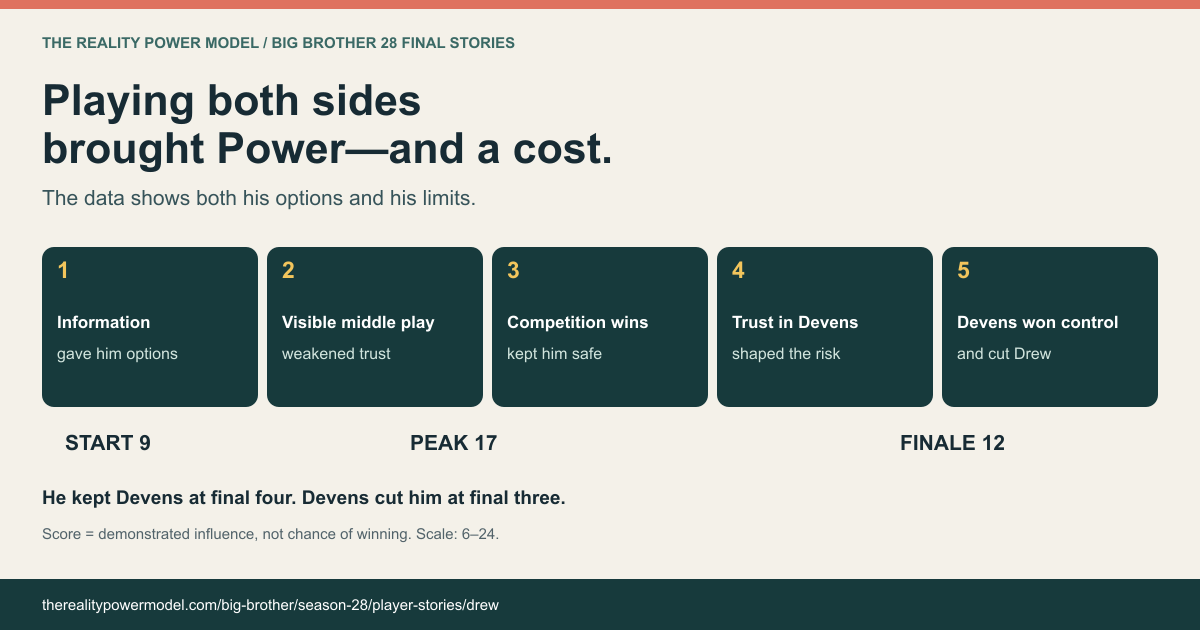
Drew trusted both his plan and his bond with Devens. The plan failed first. Then the bond failed as protection—even though the relationship itself was real.
Which claim changed most after you saw the evidence?
Research limits
This checks arguments. It does not count every fan.
This is a qualitative review of recurring arguments in selected Big Brother discussions and post-season coverage. It is not a poll of the whole audience. Repetition and upvotes do not make a claim true.
See the public discussions reviewed
Player interviews show what each player says he thought or felt. They do not independently prove every cause. Public opinion also does not change a frozen Power score.
Continue exploring Big Brother 28